
A completion rate tells you whether learners reached the end. It does not tell you whether they knew what to do next. Contextual recommendations can transform isolated modules into a continuous learning pathway.
Learning and development teams often focus on completion rates because they are easy to measure. A learner started a course, reached the final screen and received a completion mark. Yet this metric says very little about momentum. Did the learner understand the difficult section? Can they apply the skill? Did the platform propose a useful next step, or did the journey simply stop?
Modern e-learning needs to move beyond the logic of isolated modules. A strong platform should interpret what just happened and respond with an activity that makes sense. This is the role of contextual recommendations.
What makes a recommendation contextual?
A generic recommendation is based on popularity or broad category. A contextual recommendation is connected to the learner’s current situation. It may use level, objective, recent performance, recurring mistakes, preferred format, time available or previously completed content.
For example, after a learner struggles with a listening activity, the system might recommend a shorter clip with clearer speech, a vocabulary review or a pronunciation exercise using the same expressions. After a strong result, it might offer a more difficult scenario. The next activity is not random; it addresses the learning state created by the previous one.
Why the moment after an activity is so important
The end of a lesson is a decision point. The learner may continue, stop, review or leave the platform. If the next step is unclear, even motivated users can lose momentum. A well-designed recommendation reduces the effort required to decide and creates a sense of continuity.
This does not mean forcing the learner into an endless sequence. The interface should offer a small number of choices and explain their value. “Review five terms from this lesson” is clearer than “You may also like.” “Try a two-minute speaking activity to practice today’s phrases” turns a suggestion into a learning rationale.
Recommendations should respond to errors without punishing the learner
Errors are useful signals, but adaptive systems can handle them poorly. Repeating the same question immediately may feel frustrating, while sending the learner to an unrelated beginner module can feel patronizing. The better approach is remediation through a different representation.
A learner who misses a grammar question might receive a short contextual example before trying again. Someone who cannot recognize a spoken phrase might review the subtitle, listen at normal speed and then practice the phrase aloud. The platform acknowledges the gap while preserving confidence.
Build a learning flywheel, not a recommendation feed
Recommendation feeds are designed to maximize consumption. A learning flywheel is designed to strengthen capability. Each activity should produce information that improves the next recommendation, while each recommendation should create another opportunity to practice, receive feedback and demonstrate progress.
The cycle can be simple: experience, attempt, feedback, targeted practice, new attempt and reflection. Over time, the learner sees that effort changes what the platform proposes. This makes personalization visible and increases the sense of agency.
Combine learner choice with adaptive guidance
Personalization should not remove choice. Learners have different interests, constraints and motivations that no algorithm can fully infer. The best systems combine guidance with control. They present a recommended route but allow the user to select another topic, format or difficulty.
This is especially important in language learning and professional development. A learner may need business vocabulary for an urgent meeting even if the system identifies another long-term priority. Good learning design respects both the data and the person.
Use rich media as evidence, not decoration
Video and interactive media generate valuable signals. A platform can observe whether a learner replayed a segment, used subtitles, answered correctly, paused before responding or returned to a vocabulary item. These signals can improve recommendations, provided they are interpreted carefully and transparently.
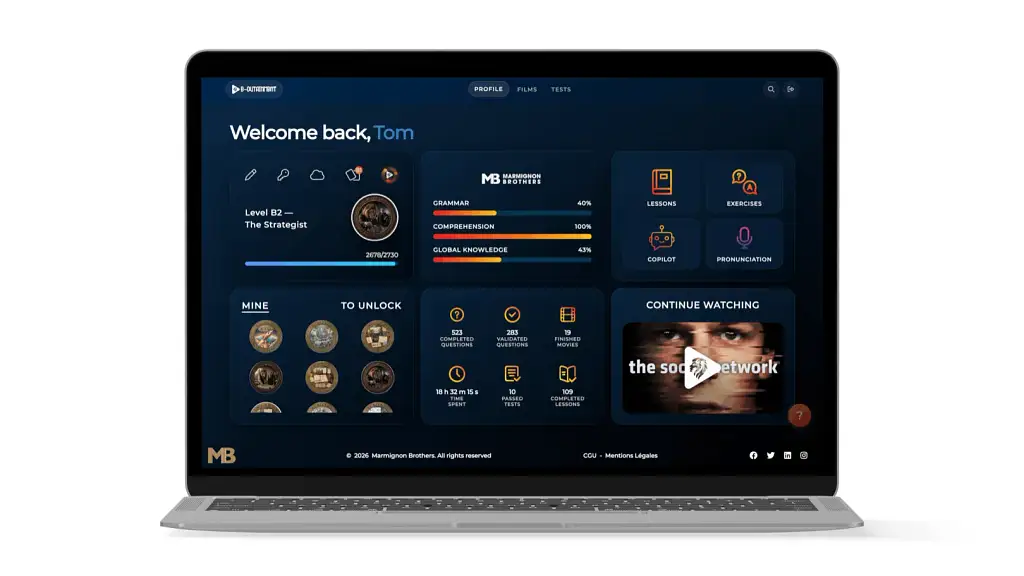
One example is a personalized language-learning platform that connects authentic video, CEFR-aligned activities, pronunciation practice and progress data to propose a useful next action. The important design lesson is not the use of AI by itself. It is the connection between evidence, feedback and a recommendation the learner can understand.
Metrics that reveal momentum more clearly
Completion rate remains useful, but it should be combined with indicators that reflect continuity and transfer. L&D teams can monitor the percentage of learners who begin a recommended follow-up, the delay between sessions, repeated error resolution, progression by skill and the diversity of activities completed.
Qualitative feedback also matters. Ask learners whether recommendations feel relevant, whether they understand why an activity is proposed and whether the next step matches their available time. Personalization can be technically sophisticated and still feel unhelpful if the explanation is poor.
A practical checklist for contextual recommendations
- Use recent performance and stated goals, not popularity alone.
- Explain the learning reason behind each suggestion.
- Offer remediation in a different format after an error.
- Limit the number of choices at key decision points.
- Preserve learner control and allow exploration.
- Measure follow-through and skill improvement, not only clicks.
The future of adaptive learning will not be defined by how many recommendations a platform can generate. It will be defined by whether those recommendations help learners recover from difficulty, maintain momentum and apply what they have learned.